For years, Lightly Row has been a staple in early string education. Its endearing melody may seem overly simple but it is rich with pedagogical value. Whether it is taught in the Suzuki books, traditionally, or in the string classroom, Lightly Row offers the perfect balance of music accessibility and technical development. When students learn Lightly Row, it is a true confidence builder. In this post, we’ll explore why Lightly Row continues to be such an effective teaching tool, how it fits into various pedagogical approaches, and ways to keep it fresh and engaging.
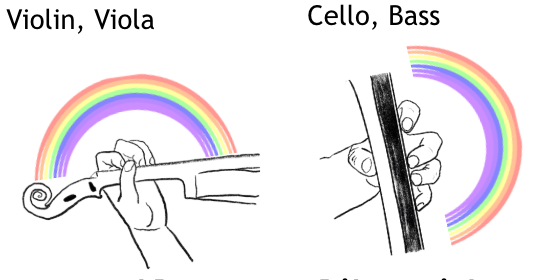
“Rainbow Shapes” and “Knuckles Up”
A preview to Lighty Row is learning how to play a “tunnel” with good posture.
If you haven’t introduced the concept of a “tunnel” yet, this is the perfect opportunity. Have students play an open A string (or open G string for bass players) while placing all four fingers down on the adjacent D string. This creates a finger “tunnel” that allows the open string to vibrate freely underneath. For the A string to ring clearly, students must maintain proper left-hand shape—with arched fingers, lifted knuckles, and rounded “rainbow” hand posture. It’s a simple yet powerful way to reinforce good technique and hand position.
TUNNEL FINGERS:
Counting in 4/4 time

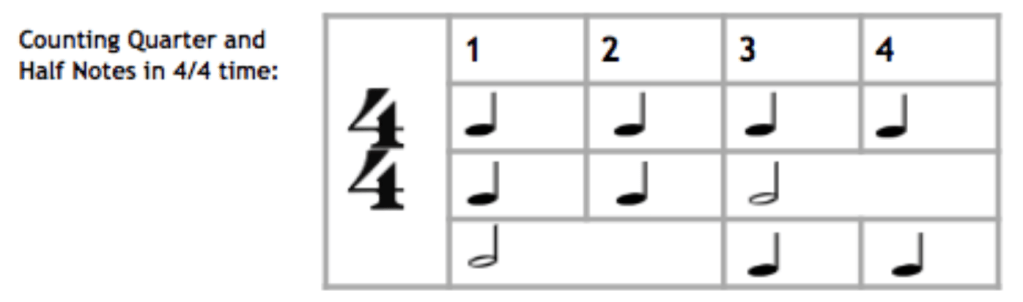
Clapping and counting Lightly Row is an excellent way to introduce or reinforce rhythmic skills, as the piece uses only half and quarter notes. In my experience, having students hold their hands together during half notes and then move their clasped hands downward on the second beat helps them physically feel the sustained duration of the half note. Encourage students to count each measure aloud as they clap, then gradually combine measures to build their rhythm-reading abilities. This hands-on approach makes rhythm concepts more tangible and accessible for beginners with the added bonus of previewing elements of note reading.
Bow Distribution
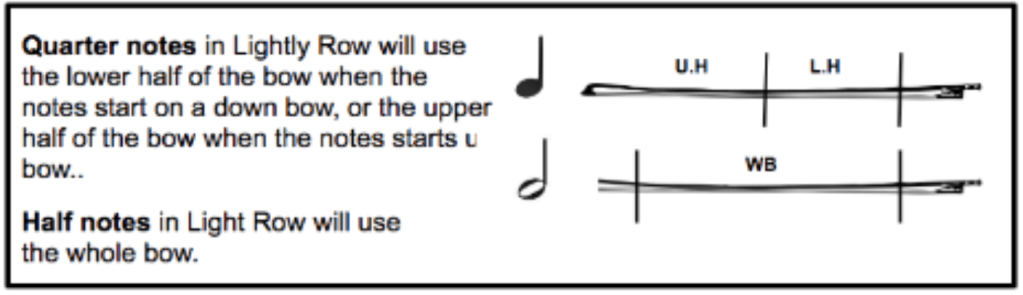
Learning how to distribute the bow is essential to phrasing and keeping a consistent tone. What’s great about Lightly Row is that the bow speed remains the same throughout (unless you are adding dynamics to the piece, see Form section).
Up the Scale to “A” We Go!

Stepwise Motion: Teaching students to recognize stepwise motion is essential for developing musical understanding. It helps them grasp how melodies move smoothly from one note to the next laying the foundation for creating and interpreting musical ideas.
I will often use the words: “up the scale to A we go” in Lightly Row to help students understand they are just walking stepwise up the D major scale from note D to A.
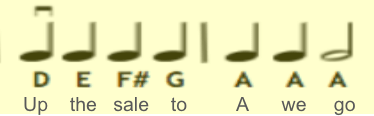
Arpeggio!

We all love a good Italian word and “Arpeggio” is no exception. The arpeggio in Lightly Row offers the perfect opportunity show students how the skipping notes of the major scale make up the arpeggio. I love how, once students learn it, they begin to recognize arpeggios everywhere in their music.
Musical Form

Form in music is essential to memorization.
Lightly Row provides a great example, as it naturally divides into four short phrases, making it easier for students to learn and remember. Teaching the piece in four distinct sections helps students recognize repetition, phrase structure, and musical patterns—key skills for both memory and musical development. Its always fun to ask a student what percentage of the song they have learned if they have learned the first two lines as they have to take into account Part 4 is the same as Part 2.
It’s not 5 E’s, but it is.

Teach counting from the bar line right from the start to build a strong sense of pulse.
Instead of saying, “It’s five E’s, then walk up,” I use phrasing that aligns with proper musical counting—like:
“E – 2 – 3 – 4, E walks up.”
This reinforces the idea of time signature, beat structure, and prepares students for rhythm reading in a musical context..
Spice it up: Lightly Row With a Twist
Even a familiar tune can come alive with creativity. Here are a few ways to make Lightly Row engaging, especially in group or individual lessons:
- Add lyrics: Singing the words (or creating your own) helps with phrasing and memory.
- Lighlty Row, Rainbow Shapes
- Up the Scale to A we Go.
- Lightly Row, Knuckles up
- Now we play ar-peg-gi-o
- E -2 – 3- 4, E walks up
- F# -2 -3 -4, F# walks up
- Lighty Row, Knuckles Up
- Now we play ar-peg-gi- o
- Use dynamics games: Ask students to play “like a whisper”, “talking with a friend”, “trying to get someones attention” , “yelling across the room” , etc.
- Create theme variations: Try playing it in different rhythms or articulations (ex: play it all staccato)
- Introduce simple harmony: Duets with a teacher or more advanced student can enrich the musical experience.
- Storytelling: Encourage students to imagine a scene or story that fits the music.
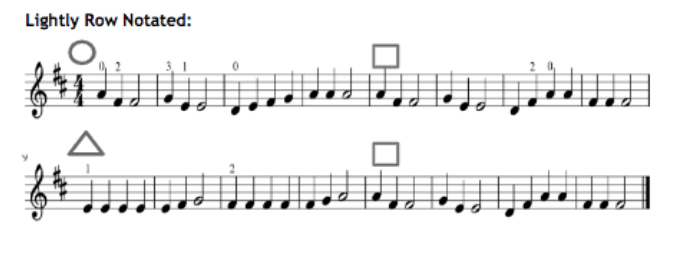
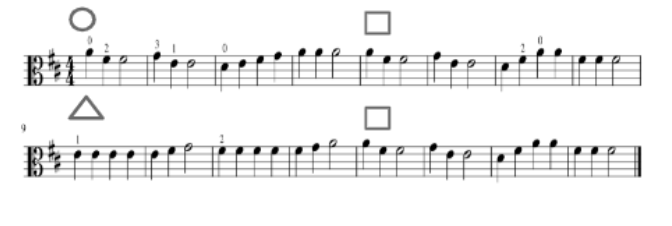
Lightly Row Music
This lightly row music below is the traditional version. The Suzuki version has straight quarter notes in Part 2 and 4. (A F# F# F#, G. E. E E). I hope you enjoy teaching Light Row as much as I do.
VIOLIN:
VIOLA:
CELLO:

BASS:

 Orchestra Bassics
Leave a comment